The Pebble Rig Develeoped by Fishing Legend Stephen Buss
 The Pebble Rig was born in August 2004 from a number of theories I had about the relationship between hook holds and free lead weight movements. No rig can really guarantee the same hook hold for a given number of times in exactly the same part of the mouth. Hook holds are the single most important part of my fishing as without a good one there is little chance of landing 200lb specimen fish. The areas that I typically fish require a minimum of a 1lb lead weight to hold bottom in the flow of the river. These lead weights were previously presented on flooded mud flats and sometimes would penetrate the surface crust of the silt and mud, hook-link and hook bait thus being buried for the duration of many a fishing session.
Hook links were lengthened initially but when hooking any size of catfish I was conscious that I only had a direct line to the 1lb lead and not the hook hold. When fishing with these heavy lead weights I had little control and direction over the fish as the lead weight would most often dictate and take the fight out of the fish for me.
The 1lb weight bounced from side to side as the catfish availed my attempt to near them to the margin for gloving, often leading the fishes head towards the river bed into snags and more often than not resulted in small tears and double hook holds in addition to hooks popping out as the fish was nearing sight. The results from 10 weeks of bad hook holds were most apparent when unhooking and repairing such damage and re-thinking my rig mechanics became a number one priority.
I have always loved the idea and fished many a time with the free lined live and static bottom bait method. The only disadvantage of this is that you are limited as to the distance fished from the bank although bite indication does not pose too many a problem. The weight is a very important factor not only to hold bottom but to aid in hook penetration as typically hook baits are sucked in and spat out.
 I had used breakaway rocks tied to weak-links initially, but under moonlight and many a spotlight I longed for a better way of presenting baits in the fastest flowing water whist not unnecessarily damaging the fish with worsened hook holds due to amount of fixed weight on the mainline. In my childhood I had played with many an elastic band and one fishing session saw the rubber band and a clip swivel in unison to form a free running retainer of heavy smooth pebbles. My initial trials saw me landing fish in addition to a 5lb pebble which not surprisingly enough is very hard to play on its own at 200 yards let alone with a Wels catfish on the end. Having experimented with several band types and numbers with different weights and shape of pebble I started to land every fish that took the hook bait and shed the pebble within seconds of the take giving a direct line to the fish. My increase and overall catch rate is made up of many factors including lady luck but are mainly attributed to the mechanics & positioning of my rigs.
 I noticed that the energy produced when the clipped band ejected the pebble was enough to hook the fish, leaving the pebble in place and the rod bent flat with a direct line to the hook hold as opposed to any awkward play from any weight used to keep hook bait in position on river bed. Over time, many pebbles were deposited in a few selected areas covering some 10km of river. These pebbles in turn formed bars and mounds on otherwise baron mud flats and were soon home to families of crayfish and regularly patrolled by the carp. When baited these areas would become a hive of activity, the types of noise, signals and movement given off was such that no catfish would resist investigation.
 Pebbles can be fished fixed or free running even though eventually they are ejected from the bands when the trap is sprung by a hungry fish. I found using fixed pebbles in certain areas required longer hook lengths due to depth of soft mud and silt. When fishing with short hook links on hard bottom the takes would be the fiercest, with the rod initially being very hard to lift from the rest due to the amount of force applied by the fast running freshly hooked fish. When fishing longer hook links nearing 1 metre in length I found typically the rod nodding away as the cat carried on feeding, moving its head from side to side oblivious of being hooked and intent on scoffing the entire free pellet that baited the trap. Hook bait presentation is also very important as this is the difference between landing and pulling out of a fish half way to the bank. When using pellet or squid hook baits I always tie a hair using 30lb 0.33mm braid to the back of the shank of the hook and present my baits on this so they are free from the bend of the hook.
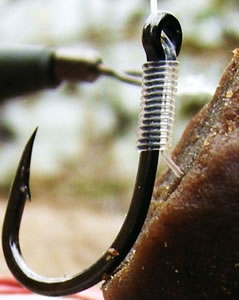 The length of my hair usually is long enough to accommodate eight 28mm drilled hook baits and looped with an over hand knot at the free end. It is important that the hook baits do not come into contact with the bend of the hook when manoeuvred as this will mask its point and result in missed takes. The hair is baited then doubled round and placed over the bend of the hook with a few securing turns to form a loop or ring of pellet that sits free from the bend of the hook.
I tend to use a knot known to me as a no knot hook knot; this is not to be confused with the knotless knot and associated hair positioning problems. My hair knot sits under the no knot hook knot which is whipped to the shank of the hook and then passed through the back of the eye in order for the hook to turn and set properly.
 The hook link is tied to a swivel with a Palomar knot, the clip swivel is either attached to form a fixed weight rig or a bead is placed on the mainline braid allowing the clip to free run. I have found that large flat smooth pebbles are best as its surface area tends less to penetrate any silt or mud crust, heavy round ones like hot potatoes are the worst for getting buried. When banding the pebble it must be done with several twists to allow the band to roll the pebble from its grasp. I have found rubber bands to be an ideal retainer due to flexibility. Bands of Velcro and bicycle tyre inner tubes are poor substitutes and often more expensive. This rig can be used in all sorts of situations from the boat or from the bank; I have presented live baits anchored to the river bed as well as the favoured meal of pellet and even used this rig on a scaled down version for my carp fishing as these pebbles in a smaller size are very castable. In addition to its rig mechanics the pebbles are capable of absorbing small volumes of flavour and oil, ideal for fish attraction. I have several tubs of casting pebbles (4 - 6 oz) permanently in soak and to an extent in certain situations they are more beneficial for fish attraction than a food source due to time release. In conclusion I will continue experimenting with this rig, however it is at a stage where it works perfectly well and as the saying goes don't fix what is not broke. I hope that you may be able to use and improve upon my success with this method.
Tightest Lines to You - Stephen Buss