Rig Zone Total Carp
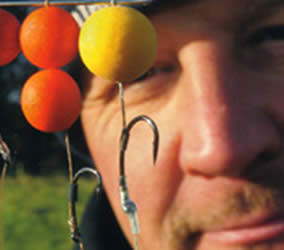 Ian Russell is an extremely experienced and successful angler. He reached the final of the British Carp Angling Championship three years in a row, winning it on one occasion. He has an impressive string of big-, carp captures to his name, up to a whopping 431b 9oz, and he manages to catch from almost every venue he visits. So why is Ian so successful? Does he have a magic bait or special rig that cannot fail? No. His success is down to watercraft and hard work.
That said, without reliable and effective rigs all of lan's hard work would amount to nothing. "At the end of the day, I'm a carp angler," says Ian. "I love catching carp, so I need rigs that are going to turn pick-ups into fish on the bank. , "Over the years that I've spent in " pursuit of carp, of which there are more than I'd care to mention, I've tried pretty : much every rig under the sun. You can end up tying yourself in knots and massively overcomplicating things. Ultimately, I have settled on a couple of rigs that I have absolute faith in. They're simple to tie; they will cover almost any situation I'm likely to find myself in and, most importantly, they work."
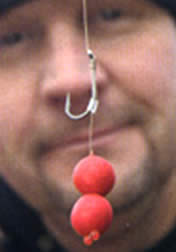 The first rig Ian unveils is a combi-link rig; consisting of a stiff boom and a short, supple braided section. "This is probably my favourite rig I'm detailing," says Ian. "It can be used with any type of bait, be it boilies, particles, artificial baits, pellets or whatever. Although this rig can be used for pop-ups and bottom baits, I don't like placing any counterbalance shot onto the braided section. As a result, I use the combi-link for bottom baits and snowman presentations.
That said, you could use a pop-up and place a shot beneath it on the hair. It's a great presentation and well worth trying. "The effectiveness of this rig lies in the stiff boom. Once a fish picks up the hook bait the stiff boom makes it extremely difficult to eject the hook without the fish backing away from the rig. Providing you have a good hook and an effective hook presentation, it should find a hold as soon as the carp back off and, bingo, you're in. "I experimented with different boom sections on the combi-link rig.
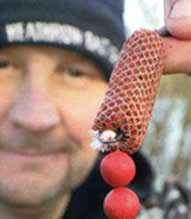 I tried fluorocarbon and stiff mono, but eventually settled on these stiff black booms called Stiff Linx, which I now sell through Heathrow Bait Services. Almost everything that settles on the lake bed and decays turns black, so these links blend in well. Also, they're so stiff that they provide the rig with the mechanics I'm after. "Keep the braided, hook section of the combi-link short. I never have a gap between the end of the boom and the hook bigger than about two-and-half inches. The boom sections I use tend to be six inches long but you can experiment with the length, as sometimes this will make a difference. "Once the rig is in the water, I want the whole lot to be laying on the bottom. Due to the stiff nature of this rig there's a chance it could stick up off the bottom if it gets caught on any debris or weed, or if it lands on a soft lake bed. Because of this, the combi-link is best fished over clear, firm lake beds."
Ian's second rig is a bottom bait rig designed for fishing bottom baits in open water. Due to the delicate nature of this rig it's no good for snag fishing, weed fishing or in any sort of hit-and-hold situation. It is good for getting a delicate presentation in open water and ideal for fooling slightly more rig-wise carp. It's a straightforward fluorocarbon hook length tied with a knotless knot.
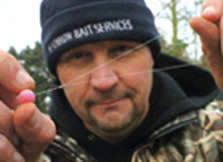 The difference is that it's tied with a doubled-over length of 6lb fluorocarbon, as opposed to one length of 12lb fluorocarbon. My pop-up rig is extremely versatile and can be suited to all manner of different situations.
"Years ago I started using Kryston Multi-Strand, which consists of lots of fine, braid fibres that separate out in the water," starts Ian. "I was never entirely happy with this presentation, so I started using multiple strands of fine fluorocarbon. As far as I'm concerned, this rig is totally invisible in water and gives a finer presentation than using one, thicker length of fluorocarbon." "So, is the idea that the fluorocarbon strands separate out in the water, just like the Multi-Strand?" I ask. "Well, they may separate out, but the chances are slim," replies Ian. "The main advantage is that two strands of 6lb fluorocarbon are finer and more supple than one strand of 121b. This allows the rig more movement in the water, giving a better presentation. "One thing you must remember with this rig is that the two lengths of fluorocarbon must be exactly the same. If one's longer than the other then you'll end up with a hook length that breaks at 61b, as opposed to 121b."
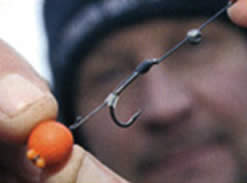 The third and final rig that Ian reveals is his Go-Anywhere pop-up rig. There's nothing fancy here, it's a simple hook length tied using a coated braid with a shot pinched onto it just below the hook.
"This is my pop-up rig," starts Ian. "It can be used for bottom baits too, but because the Stealth Skin material that I use is so tough, I have no problem with pinching shot onto it to counterbalance a pop-up. Unlike fluorocarbon, mono and fine braids, placing a split shot onto a coated braid doesn't weaken it; hence it's my choice of material for a pop-up rig. "Unlike the other two rigs, this one can be cast anywhere in the lake. It'll fish just as well over silt and debris as it does over gravel, sand and such like. It's strong enough to be used in weedy waters or near to snags and can be fished just as effectively in open water.
It's extremely versatile and can be suited to all manner of different situations. You can leave all of the coating on the braid for a stiffer presentation. If you place a shot onto the hook length with all of the coating left on, then the hook will sit off the bottom at a slight angle. Conversely, if you strip the coating between the shot and the hook, then the hook and bait will sit directly above the counterbalance shot. You can also suit the rig to your own preference by playing around with the amount of coating you strip off." Ian goes on to explain that although this rig will work pretty much anywhere, you need to take into account the type of lake bed you're fishing over.
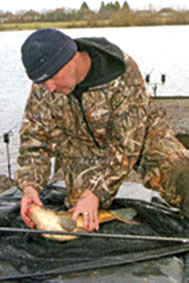 If it's extremely soft then it's worth lengthening the rig to 12, or even 14, inches to ensure that the hook bait isn't pulled into the lake bed and buried out of sight when the lead hits the bottom. "You may have noticed that I use the same hook pattern for all these rigs," says Ian. "Although I do use other hook patterns, long-shanked hooks with an in-turned eye, such as the Kamasan B175 or ProLogic C3, are by far my favourite. I have absolute confidence in this hook pattern and have lost very few fish on them. "The only tubing I use on my rigs is a tiny piece of silicone tubing placed on the shank. This ensures that the hair leaves the shank in the right place and creates a blowback effect. I don't use any tubing over the eye of the hook, simply because I don't think it's needed. The turning potential of this style of hook is good enough without adding pieces of tubing and suchlike. In fact, none of the anglers I fish with use tubing. It makes the rigs that little bit more difficult to tie." On the theme of keeping it simple, Ian explains that he only uses two knots for tying his rigs, the knotless knot and a four-turn grinner. "I know that a grinner is a strangulation knot and some people think it's too weak," says Ian.
"I've used it since I was a nipper and it's never let me down.” People always ask me about the length of hook length that they should use. You need to remember that there's nothing standard in carp fishing. I'm forever playing with my rigs, especially the length, to get the right presentation on the day.
I would advise you to start with a hook length of about six inches and work up from that if you're not catching. "The problem with doing an article like this is that it's difficult to come up with any definitive 'rules' to tying rigs. The most effective rig could change on any given water from day to day. If I'm completely honest, then a lot of success with rigs is down to trial and error. Because of this I leave myself options when I pre-tie rigs. I never set the length of the rig, or the length of the hair. This way, you can adapt your rigs to any given day. However, the majority of the rig is pre-tied, saving you lots of time." So there you have it, Ian Russell's three favourite rigs of all time. Why not give them a go and see if you can enjoy some of the same success that lan has had?
Write up and images courtesy of Total CARP